


Changing the orientation of an individual, company or public institution from linear to circular requires a lot of changes. First of all, in the way of thinking, then in the processes of behavior and action. Here, it is expedient to set ambitious, but at the same time achievable goals. We do not strive for perfection, but it is important to start, to start immediately and then to persist.
As part of the European project CircLocal, which promotes circular public procurement, we created a manual with practical advice on how individuals, companies and public institutions can contribute to the circular economy.
The municipality of Novo mesto, in cooperation with the Knof Institute, has prepared a manual that will help individuals, companies and public institutions in finding ways to most effectively contribute their share to the transition from a linear to a circular economy. Zavodom Knof pripravila priročnik, ki bo posameznikom, podjetjem in javnemu institucijam v pomoč pri iskanju poti, kako najbolj učinkovito prispevati svoj delež k prehodu iz linearnega v krožno gospodarstvo.
The manual contains an analysis of waste streams in our local environment, concrete advice on what we as individuals or organizations can do to reduce the amount of waste and contribute to the launch of a circular economy, as well as examples of good domestic and foreign good practices.
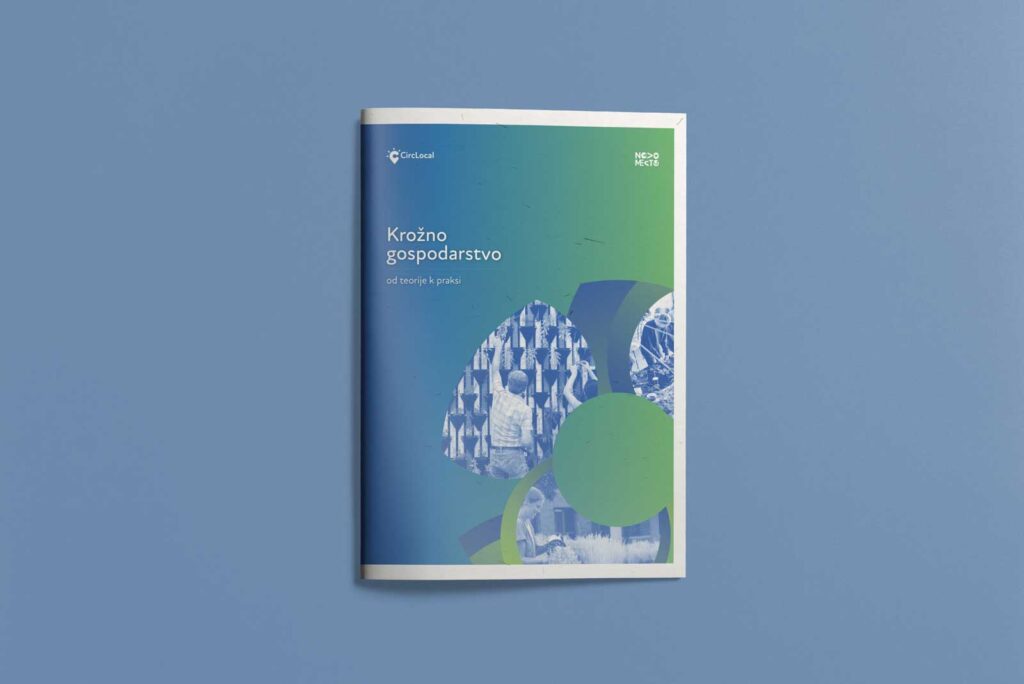
View the manual "Circular economy from theory to practice"
What can we expect in the coming years
In the coming years, a revolution will take place in the field of recycled raw materials in the form of a transition to a circular economy. Our baskets will become treasures. It is naive to expect that we can leave the uncontrolled accumulation of garbage to municipal companies and other collection centers. The responsibility lies primarily with the manufacturers, who still mostly design products based solely on the criterion of yield and without the ecological cost.
We can expect states and utilities to change their business models and redistribute their burden between businesses and households in the near future. Companies that will use raw materials will be taxed more, which will lead to a higher demand for recycled raw materials.
We can expect higher payments for waste management. This will lead to a demand for products without waste packaging and to the search for alternatives to reduce monthly waste costs.
Companies will be forced to change their business models and abandon the current mass production. First of all, it will be necessary to fundamentally change the product design. Every product will need to have a designed life cycle. The form of production will be determined in advance (renewable resources, ethical, ecological production, recycled materials...), distribution and extension of the life cycle (repair, processing, reuse), and finally, simplified recycling will be important.
